 Daniel Mitchell
Key Takeaways
- The flow meter is a turbine sensor that tells the Miele control board how much water has entered the drum; F19 means that signal is not valid.
- It is usually worth fixing: the F19 page puts a typical repair from $150, and most causes are sediment, air, pressure or wiring.
- Do not keep using the washer with F19, because the board can overfill or underfill without accurate readings.
- Cleaning the inlet filter, flushing air from the hose and a five-minute power-off cost nothing and come first.
- A fault that appears once points at debris or air; one on every cycle points at the sensor.
The Bottom Line
On a sound machine the flow meter is worth fixing, from $150 for a typical repair; check the inlet filter and the supply first. If the washer is old and already needs bigger work, weigh the whole estimate before the sensor.
A washing machine has to know how much water it has let in, and on a Miele that job belongs to a small turbine called the flow meter. It spins as water passes, a sensor counts the turns, and the control board turns the count into a fill level. When the count stops making sense, the machine raises F19. This guide is about that single part and whether it earns a repair; for the age-based view of the whole washer, start with our guide on whether a Miele washing machine is worth repairing.
| What the code page lists | Who can fix it | Worth fixing? |
|---|---|---|
| Sediment in the inlet filter or turbine | Owner, with the hose off | Yes, it costs nothing |
| Air in the water line after plumbing work | Owner, by flushing the hose | Yes |
| Low water pressure | Owner or plumber | Yes, fix the supply first |
| Loose or damaged sensor wiring | Technician | Yes, usually a short visit |
| Failed sensor in the flow meter | Technician | Yes on most machines, weigh the age |
Is a Miele Washing Machine Flow Meter Worth Fixing?
Yes, in most cases, because the flow meter is a sensor and not a major mechanical assembly. The F19 page puts a typical repair from $150 with a visit of about 45 minutes to an hour and a half, which is small next to the cost of a new Miele washer. The final price is confirmed after diagnosis on site, with a written estimate before any work begins.
The question changes only when the washer is old and has other problems waiting. A flow meter repair on a machine that also needs a drum bearing or a control board is a bad place to start spending, and the parent guide explains how to weigh that. On a machine that is otherwise sound, F19 is one of the cheaper faults to have.
Why F19 Is Not Something to Live With
Because the board is working blind. The code page says the machine may overfill, which is a flood risk, or underfill, which can damage the heater, and it rates the machine as not safe to keep using until F19 is resolved. The symptoms it describes are an overfill or underfill, a cycle that stops during the fill phase, different water levels from one cycle to the next, and F19 appearing at the very start of a cycle.
- Overfilling. This is the one to take seriously: stop the machine and close the tap if water keeps coming.
- Inconsistent levels. If the same program uses visibly different amounts of water, the count is unreliable.
- Stops at the fill phase. The board aborts when it cannot verify the volume.
If you notice water standing on the floor after a cycle, read our guide on washing machine flooding prevention before the next load.
Can You Fix F19 Yourself?
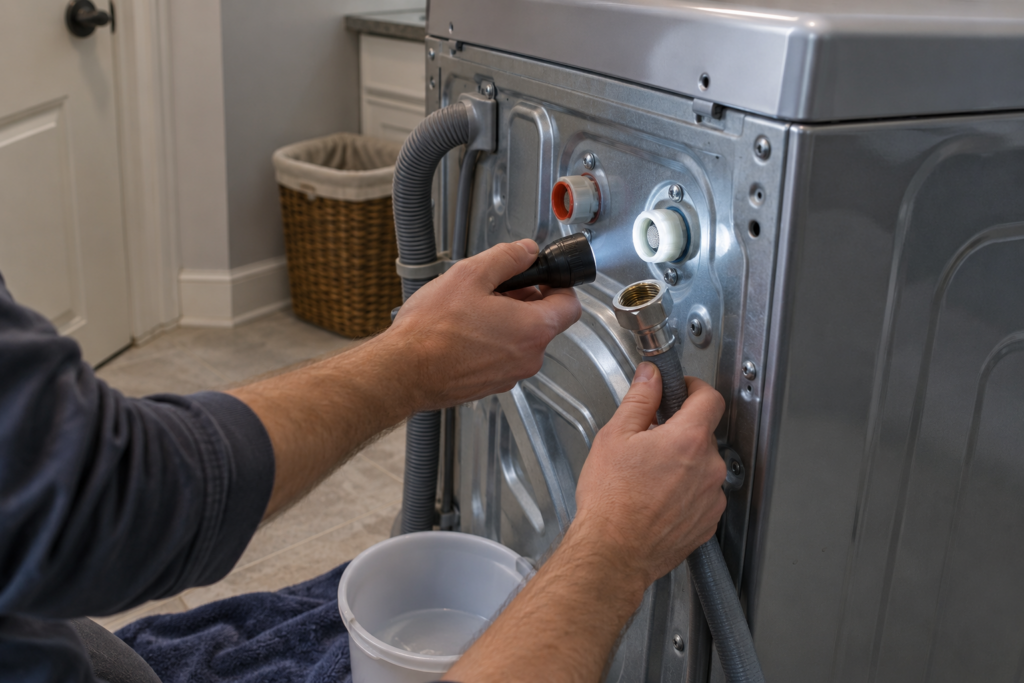
Sometimes, and the code page lists three checks that cost nothing before anyone is paid. A clogged inlet filter, air in the line and low pressure are all in the category the page marks as possible for the owner to deal with.
- Check the water supply. Make sure the tap is fully open and that a nearby tap shows normal pressure.
- Clean the inlet filter. Unscrew the inlet hose and wash the mesh filter; the page notes that sediment reaching the flow meter is a common cause. Have a bucket and a towel ready.
- Bleed the air. Disconnect the hose, flush it briefly into a bucket, then reconnect it, which helps if the plumbing was recently worked on.
- Power off for five minutes. The flow meter controller may need to recalibrate.
- Run two or three more cycles. Keep a note of the results.
With the machine unplugged, take care not to pull on any wiring behind the hose connection. If you are not comfortable removing the hose, leave it for the visit; nothing here should need a screwdriver.
How Do You Tell Debris From a Failed Sensor?
By how often it comes back. The code page says that a fault that appears once and then goes away points at debris or air, while a fault on every cycle points at the sensor itself. That is why the note in the last step matters: it turns your tests into information a technician can use.
A technician will check what the page lists next: a turbine that is stuck, the sensor wiring, and the sensor. It also tells you what to expect from the repair, since a stuck turbine or a loose connector is a quicker job than a failed sensor. Mention the recurrence pattern and what you cleaned when you book, and ask whether the part is being replaced or cleaned.
What a Flow Meter Visit Should Cover
A repair that is worth the money starts with a diagnosis that rules the cheap causes out first. The code page names the checks a technician works through, and you can hold the visit to them. Ask for the result of each one, not just the final part name.
- The inlet filter and the supply. If sediment or low pressure caused the fault, the repair is a clean and nothing more.
- The turbine. A stuck or jammed turbine is a different job from a failed sensor, and it should be priced differently.
- The wiring between the sensor and the board. A loose or damaged lead can mimic a dead sensor.
- The sensor itself. The page calls the Hall-effect sensor the part that needs a professional when it has failed.
Because the visit is short, the labor is the smaller part of the bill, so an estimate that looks much bigger than the from $150 on the code page deserves a question about what else was found. Keep your notes from the home checks to hand: the number of cycles you ran, whether the code came back each time and what you cleaned all shorten the diagnosis.
When Is the Flow Meter Not Worth Fixing?
When the machine as a whole is no longer worth the money, not because of the sensor. Our washing machine cost guide describes the 50 percent rule: if the total repair is more than half the price of a comparable new Miele, consider replacing, and it leans toward repair for machines under ten years old and toward replacement for machines over fifteen. A flow meter repair alone rarely reaches that line, but it can be the third or fourth item on the same estimate.
- Several faults at once. A sensor repair is a poor place to start on a machine that is also showing other problems.
- Three or more service calls in a year. The worth-repairing guide treats that as a pattern to take seriously.
- Corrosion on the drum assembly. The same guide calls it a likely end-of-life signal.
For the full price picture, see the washing machine repair costs guide. A flow meter also appears on the dishwasher side, and our dishwasher flow meter guide explains how sediment and air cause the same kind of fault. Our washing machine repair service covers F19; schedule a visit or contact us with the code, how often it appears and what you have already cleaned.