 Daniel Mitchell
Key Takeaways
- F84 reports a heating element or temperature control fault — the water is not reaching the temperature the program needs.
- The code covers both the heater and the NTC sensor, which is why the cost spread between cases is so wide.
- Descaling and a filter clean resolve part of the cases outright and cost nothing but a cycle.
- The site puts an F84 repair from $150, with the final price confirmed after the on-site diagnosis and a written estimate first.
- A burning smell, or F84 alongside F85, F70 or F24, means stop using the machine and have it looked at promptly.
The Bottom Line
Run a descaling cycle and clean the filters before you call — that clears the cheapest cause for free. If F84 returns within a cycle or two, the heating element or the temperature sensor has failed and only a measurement will tell you which.
When a Miele dishwasher F84 error code turns up, the question that follows is always about money rather than about parts. The answer depends almost entirely on which of five things went wrong, and those five are not close to each other in cost. One is a descaling tablet and an empty cycle. Another is the main control board. Knowing which tier you are in before the technician arrives is the difference between a decision and a surprise.
| What failed | How often it is the cause | Where it sits on the bill |
|---|---|---|
| Limescale on the heating circuit | Common in hard-water homes | Lowest — often an owner task |
| Heating element | The leading cause, around four in ten | Middle — the usual F84 repair |
| NTC temperature sensor | Frequent, and easy to mistake for the element | Middle — part is small, access is the work |
| Wiring or loose connections | Occasional | Lower — labor rather than parts |
| Control board | Least common of the five | Highest — changes the repair-or-replace math |
What You Are Paying to Fix
The F84 page on this site defines the code as a heating element or temperature control fault: the control system has detected a problem in the heating circuit or the temperature sensor, and the water is not reaching the temperature the program needs. Note that the code covers both the thing that makes heat and the thing that measures it. That is why the cost spread is so wide.
A machine that heats fine but reports wrongly is a sensor job. A machine that reports correctly and cannot heat is an element job. From the outside they look identical — cold dishes, greasy residue, cycles that run long — and no amount of reading the display will separate them. This is the part of the bill that buys information rather than parts.
The Tier Where You Do the Work
Before anyone is called, two of the five causes are worth eliminating yourself, and both are free or close to it.
- Run a descaling cycle. Heavy scale on the heating circuit reduces its efficiency and can trigger the temperature fault directly. Use a proper descaler and run the hottest program empty.
- Clean the filters. The coarse filter and the fine mesh both affect circulation, and circulation affects how the machine reads water temperature.
- Cut power for five minutes. A full mains reset — not the button — clears a transient fault in a modest share of cases.
- Check the hot water supply. If the machine takes a hot feed, run the kitchen tap for half a minute first so hot water is at the connection rather than a pipe's worth away.
If F84 clears after descaling and stays cleared, you have found your answer and spent nothing. If it comes back within a cycle or two, the fault is real and the descaling was not wasted — the technician now starts from a clean circuit.
What the Actual Repair Involves
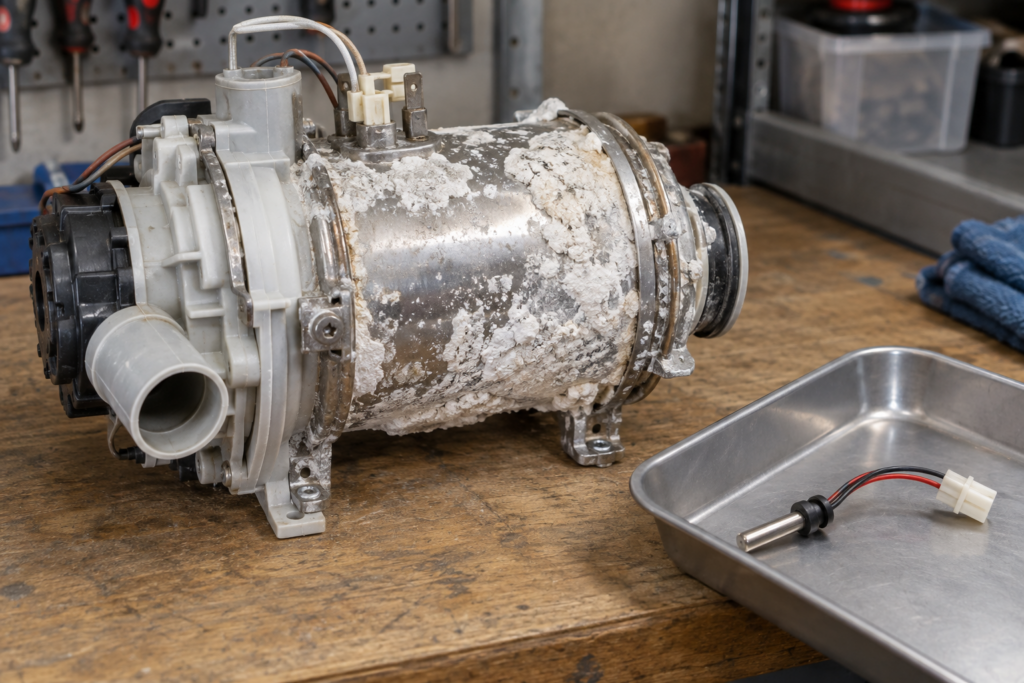
On a modern Miele the heating function is built into the circulation assembly rather than sitting as a visible coil in the bottom of the tub. That design is the reason the dishes never scorch and the reason the job is not a do-it-yourself one: reaching the assembly means dropping the machine out of its cabinet, and the circuit is interlocked with the water sensing and the door.
The site's own figure for an F84 repair starts from $150, with a typical bench time of one to two hours. As always, that is a starting point rather than a quote. The final price is confirmed after the on-site diagnosis, and you receive a written estimate before any work begins — a rule that exists precisely because this code can resolve to a sensor or to a board.
What Moves the Number Up
Three things push an F84 repair toward the expensive end, and all three are visible before the technician opens anything.
- Company it keeps. F84 arriving alongside F85, F70 or F24 suggests the problem is not confined to the heating circuit.
- A burning smell. Stop using the machine. This moves the job from a scheduled repair to something that should be looked at promptly.
- Repeat resets. A code that survives three power cycles is not a glitch, and continuing to reset it only adds wasted cycles to the tally.
- Age. Past the ten-year mark, a control board repair is where owners start weighing a replacement instead.
Related heating codes are worth reading in the same sitting. F14 also reports water not reaching temperature, and a machine that has shown both is telling a more consistent story than one that showed either once.
Is the Repair Worth It?
For most Miele dishwashers the answer is yes, and the reason is the design life of the rest of the machine. These are built around long service intervals, and an eight-year-old unit with a failed heating element still has a sound pump, a sound tub and a sound door. Replacing one component in that context is straightforward value.
The calculation changes when the fault is the control board on an older machine, or when the heating fault is the second significant repair in a short period. Our guide to Miele dishwasher repair cost by code sets F84 against the other common faults so you can see where it falls relative to drainage and intake work.
Booking the Diagnosis
A heating fault cannot be quoted over the phone, because nobody can tell an element from a sensor without measuring both. Our appliance diagnostics visit reads the stored codes, tests the heating circuit and the temperature sensor, and leaves you with a written report and a repair estimate before you commit to anything.
Two things help before the technician arrives: run the descaling cycle, and write down whether the dishes come out cold, lukewarm, or merely poorly cleaned. Then book a visit and hand that over at the door.