 Daniel Mitchell
Key Takeaways
- On a Miele washer under about ten years old, a failed heating element is usually worth fixing.
- F20 means the heater ran but the water did not warm; F29 means the heater circuit was never switched on.
- A 60 degree cotton cycle and a feel of the door glass after 20 minutes tells you whether the heater works.
- Descale and reset at the mains before paying for a part: scale and board glitches both mimic a dead element.
- On an older machine with a second fault, add the estimates together before agreeing to the first repair.
The Bottom Line
Descale, reset and test the door glass first; if the water still stays cold, a heater repair is usually a good use of money on a younger Miele. The price is confirmed after diagnosis, with a written estimate before work begins.
A washing machine that stops heating its water is one of the clearer repair decisions, because the part at fault is small, easy to name and priced well below the machine. It is one part of the broader question we answer in the guide on whether a Miele washing machine is worth repairing, and this article takes only the heater: when it is the real fault, when it only looks like one and where the money stops making sense.
| Situation | Worth fixing? | Why |
|---|---|---|
| Machine under ten years old, heater failed | Yes | A small part against a long remaining life |
| Water heats poorly, limescale suspected | Try a descaling cycle first | Scale insulates the element |
| Breaker trips when heating starts | Yes, but stop using hot cycles | A safety sign: the code pages say stop |
| Heating also fails with a second fault | Weigh the total estimate | Two repairs change the arithmetic |
| Washer over fifteen years old with a drum fault | Probably not | The heater is not the only cost |
Is a Miele Washing Machine Heating Element Worth Fixing?
On most machines under about ten years old, yes. The cost guide on this site lists a heating element repair from $150 with parts and labor, which is far below half the price of a comparable new Miele washer, the line our 50 percent rule uses to push a decision toward replacement. Miele washers are built for long service lives, so a part that restores full function usually buys back years you have already paid for.
The decision turns on whether the element is really the fault. The F20 page says a failed element is the most common cause, at around half of cases, but not the only one, and a repair quote that names the heater without any test behind it deserves a question.
How Can You Tell the Heater Is the Problem?
By checking whether the water ever warms. The code pages give a simple test that needs no tools: run a 60 degree Celsius cotton cycle and feel the door glass after about 20 minutes. Warm glass means the heater is working; cold glass on a hot program confirms a heating problem. Laundry coming out cold after a hot wash, stains that need hot water staying put and a cycle that runs much longer than usual are the matching signs.
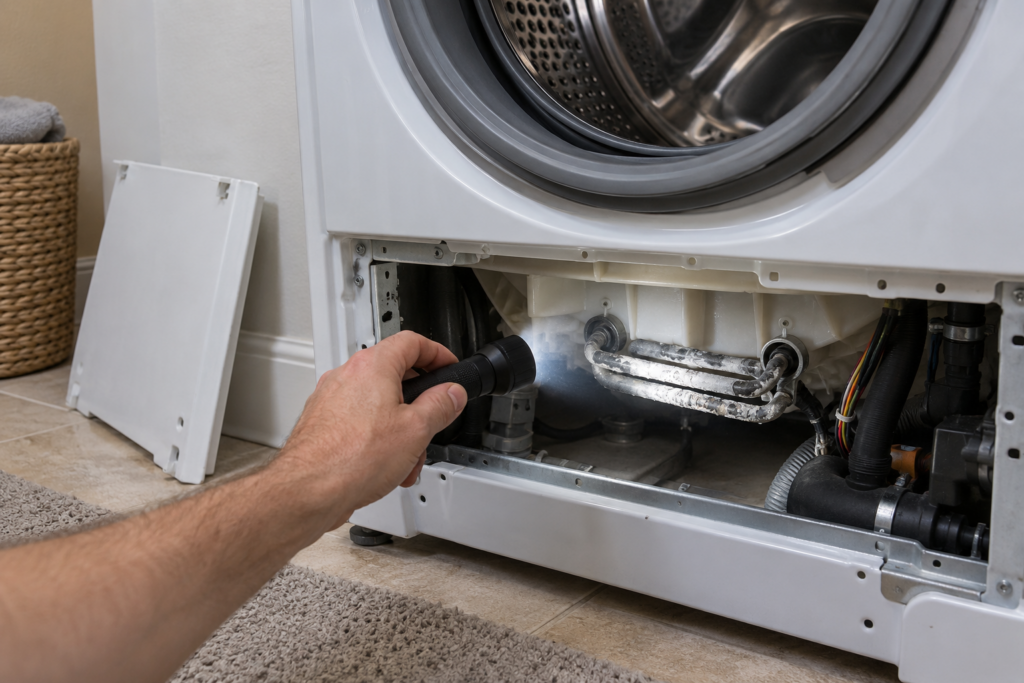
The machine will also tell you with a code. F20 and F29 are the two heating codes, and they point at different places, which matters for the price.
- F20, heating problem. The control board switched the heater on, but the water did not reach the programmed temperature in the allowed time. The F20 page lists a failed element, a defective temperature sensor, limescale, a wiring fault and a relay failure.
- F29, heating not activated. The heater circuit was never switched on. The F29 page names a relay failure on the board, an open circuit in the heater, a wiring fault, a sensor reading wrongly and a software glitch.
What Should You Rule Out Before Paying for a New Element?
Limescale, a power glitch and a simple cold-water fault, in that order. All three are cheaper than a heater, and the code pages recommend them for that reason.
- Run a descaling cycle. Use Miele descaling tablets and a 95 degree Celsius maintenance wash with an empty drum. The F20 page recommends descaling every three to four months in hard-water areas.
- Reset at the mains. Five minutes off for F20, ten for F29. A transient board or sensor glitch may clear; a failed heater will bring the code back.
- Run a cold cycle. If it finishes normally, the machine itself is sound and the fault is isolated to the heating system.
- Try other temperatures. The F29 page suggests running 40, 60 and 90 degree programs. A fault that shows on only one of them points at a program-specific cause.
Hot-water programs will not clean well while the heater is down, but cold programs are safe in the meantime. Stop using the washer altogether if it trips the household breaker or you smell burning; both signs are on the code pages as reasons to stop.
Be honest about how you use the machine, too. A washer that is run mostly on cold programs may have had a dead heater for months before anyone noticed, and the clue is usually a code or a stain that did not lift. If the first sign is F20 or F29 after a long run of cold washes, the heater may simply have failed from age and not from anything you did.
When Does a Heater Repair Stop Making Sense?
When the washer is old enough that the heater is the first of several repairs. A single heater fault on a young machine is a good repair. The same fault on a machine over fifteen years old, with a drum that is also noisy or a door that no longer seals, is a different conversation, and the arithmetic belongs in the guide on repair or replace for a Miele washing machine.
- Two faults at once. Add the estimates together before agreeing to the first.
- Control board involvement. If a relay on the board is the cause, the quote moves to a board repair, which is priced separately.
- Repeat visits. A heater replaced twice in a few years suggests something else is stressing it, such as heavy scale or a wiring fault.
- Warranty status. A heater failing inside the warranty period belongs with the warranty, not with your wallet.
What to Tell the Technician Before the Visit
A few facts shorten the diagnosis and keep the quote honest, because they separate a failed element from the cheaper causes before anyone opens the machine. Write them down while the symptom is fresh.
- The code and when it appeared. Mid-wash, at the start of heating or after a power cut all point at different parts.
- Which programs fail. Whether the problem shows on 40, 60 and 90 degrees or only on one of them.
- The door glass result. Warm or cold after about 20 minutes on a 60 degree cotton cycle.
- Your descaling history. The date of the last maintenance wash, and whether you live in a hard-water area.
- Any breaker trip or burning smell. Say so before the visit, because both are reasons to stop using the machine.
With those answers a technician can arrive with the likely part, and you can compare a written estimate with the figure in our cost guide.
What the Visit Looks Like
A technician will confirm the heating fault before ordering anything. The usual sequence is a temperature check, a test of the element and the sensor, a look at the wiring and the relay on the board and then a written estimate. Final pricing is confirmed after diagnosis on site, with a written estimate before any work begins, and the code pages put a heater visit at one to two hours.
For the wider price picture, the washing machine repair costs guide lists the other common repairs side by side. Our washing machine repair service covers both heating codes. Schedule a visit or contact us with the code, the temperature program that fails and the model number.