 Daniel Mitchell
Key Takeaways
- A single F40 on a Miele dishwasher is almost always a harmless software glitch; a ten-minute mains power-off usually clears it.
- F40 repeating more than two or three times in a week makes a failing control board likely.
- Repairing the board is worth it when it is the only confirmed fault and the rest of the machine is sound.
- A diagnostic separates a loose ribbon cable or power problem from a genuine board failure.
- The final price is confirmed after on-site diagnosis, with a written estimate before any work begins.
The Bottom Line
A Miele dishwasher control board is usually worth fixing when it is the only fault, but a single F40 is not a board failure. Reset for ten minutes, log recurrences and pay for the diagnostic before authorizing a board.
A Miele dishwasher that stops mid-cycle, ignores the buttons or flashes F40 makes owners think of the control board, and the next thought is that boards are expensive. Both thoughts are reasonable and both can be wrong: this site's F40 page says a single occurrence is almost always a harmless glitch. This guide separates the glitch from the failing board and then answers the worth-fixing question for the machine that is left. It is a decision guide for the board, so for the machine as a whole start from the parent guide, is it worth repairing a 10-year-old dishwasher.
| What the machine is doing | Most likely meaning | Is a board repair worth it? |
|---|---|---|
| F40 once, gone after a power reset | A transient software glitch | Nothing to repair; keep watching |
| F40 several times in a week | A deeper board problem is likely | Yes, if the rest of the machine is sound |
| Buttons freeze until the power is cycled | A control panel the board no longer answers | Get it diagnosed before deciding |
| F47, board and display lost contact | A cable, connector or board fault | Often yes; a cable is the cheap outcome |
| Several unrelated codes at once | A board misreading its inputs | Worth a second opinion first |
Is a Miele Dishwasher Control Board Worth Fixing?
Yes, in most cases where the board is genuinely the fault and the rest of the machine is in good shape. This site's repair cost by fault code guide makes the point that a Miele control board on a fifteen-year-old machine can still be a reasonable decision, because the mechanical parts around it are not tired the way another brand's would be.
The condition in that sentence is the important part. A board repair is worth doing when the board is the only thing wrong, and not worth doing when it is the first of several failures. Most of the cost of getting this wrong comes from paying for a board when the real fault was a cable, a power supply problem or a glitch that a reset would have cleared.
How Do You Tell a Glitch From a Failing Board?
By how often it happens and what clears it. The F40 code page describes it as an internal software or communication error on the control board, most often a transient glitch, and recommends a full mains power-off for ten minutes. A glitch clears and stays away; a failing board comes back.
- Switch the dishwasher off at the mains, not just with the power button, and wait ten minutes so everything discharges.
- Plug it in directly or confirm a dedicated circuit; sharing an outlet with a kettle or microwave can destabilize the board.
- Run a short cycle from start to finish and watch the display for any phase that takes unusually long.
- Keep a log of the date, time and cycle phase each time F40 appears.
- Count the recurrences: the page says more than two or three in a week makes a deeper board issue likely.
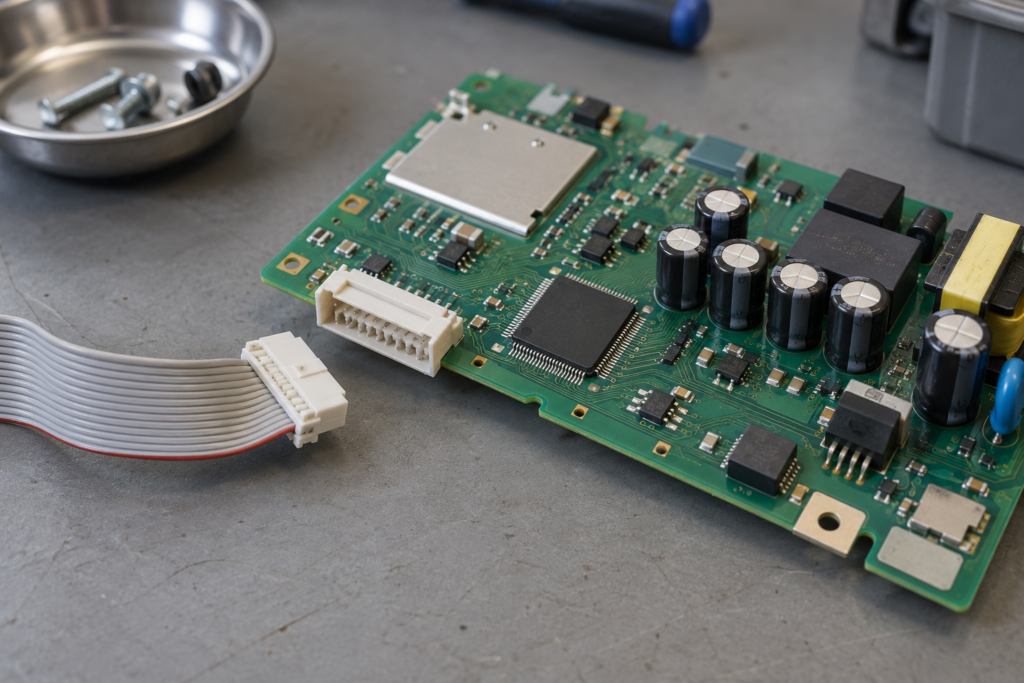
Storms and unstable mains deserve a mention here. If your area has frequent power fluctuations, the page suggests connecting the dishwasher through a surge protector rated for appliances, and that suggestion is worth acting on before a board is replaced, because a new board on the same unstable supply can be upset in exactly the same way.
The Two Board Faults Behind These Codes
The two codes in this guide point at different weaknesses, and the difference changes the price. F40 is the board talking to itself, while F47 is the board and the display panel losing each other. This site's F47 page describes the two boards exchanging data constantly during operation and a machine that cannot proceed safely when the link breaks.
- Corrupted memory on the board: the F40 page lists the non-volatile memory chip as a cause, through age or electrical stress.
- Degrading components on the main board: capacitors and similar parts causing intermittent processing errors.
- A loose ribbon cable or connector: the flat cable between the user interface and the main board, loosened by vibration or heat cycling.
- Power quality: unstable mains voltage that upsets a perfectly healthy board, which a surge protector rated for appliances can reduce.
The ribbon cable is the happy outcome, because a connector reseat or cable replacement costs far less than a board. Only a technician can tell which of these you have, and that is exactly what a diagnostic is for.
What Does a Miele Dishwasher Control Board Repair Cost?
From $349 for the board on this site's cost guide, with the final price confirmed after on-site diagnosis and a written estimate before any work begins. A diagnostic tests the circuit the code points at rather than reading the display back to you, which is why it is worth paying for before authorizing a board.
One more rule from the same guide is useful here: several unrelated codes at once usually means the board is misreading its inputs, not that several parts failed, while a single code that returns after every reset more often means the sensor that code refers to. Either way, write down every code before clearing it.
Questions to Ask Before Authorizing a Board
A board is the one dishwasher part where a second question is cheap and a wrong answer is costly, so it is worth having the technician explain the diagnosis before you approve the work. The aim is to be sure the board is the cause and not a stand-in for something nearby.
- Was the ribbon cable between the display and the main board checked and ruled out?
- Is the supply voltage steady, and was the dishwasher on a circuit of its own during the fault?
- What did the diagnostic measure that points at the board, as opposed to the display panel?
- Is the repair priced as a board swap or a repair, and what does the service warranty cover afterward?
Those four answers also tell you something about the technician. A clear explanation of why the board is at fault, with the cable and the power ruled out, is what a board repair worth paying for sounds like.
When Is Replacing the Dishwasher the Better Choice?
When the board is one of several tired parts, or the tub, pumps and seals are all showing their age at the same moment. A new board in a machine that then needs a drain pump and a door seal is three repair bills for one appliance, and that is the point to compare the total with a new dishwasher.
- Repair the board when it is the only confirmed fault and the machine otherwise cleans, drains and seals as it should.
- Look at replacement when a diagnostic finds the board plus other major components worn.
- Do nothing yet after a single F40 that a power reset cleared; log it and move on.
For the wider rule of thumb, see Miele dishwasher repair vs replace, and for what the common faults cost, average dishwasher repair cost. The Miele dishwasher repair service covers control board and sensor work, and you can schedule a visit with your fault log and the model number ready.