 Daniel Mitchell
Key Takeaways
- F51 is a pump that will not start, F78 a pump that runs but is overloaded, and F53 a lost speed signal; they do not cost the same.
- Most causes are blockages, grease or sensor faults, so a Miele circulation pump is usually worth fixing.
- About one F53 case in five is a one-time glitch that a ten-minute power-off clears.
- Stop using the dishwasher while the code shows: a pump under load can burn out and turn a cleaning job into a motor replacement.
- Multiple failures, rust in the tub or the same code returning after a repair are the real reasons to replace the machine.
The Bottom Line
A circulation pump fault is worth fixing in most cases, because blockages and sensor faults are common and cheap. Stop using the machine, run the safe checks, and ask for a written estimate if the code returns.
The circulation pump is the part of a Miele dishwasher that turns clean water into a wash. It pushes water through the spray arms, and when it fails the machine fills, heats and drains as usual while the dishes come out untouched. Three codes on this site point at it, each describing a different failure, and they do not all deserve the same answer on the repair-or-not question. This guide is about that one part, not the whole machine; for the age-based view of the whole dishwasher, start with our guide to a 10-year-old Miele dishwasher.
| Code | What the pump is doing | Usually worth fixing? |
|---|---|---|
| F78 | Running, but overloaded or slow | Yes, if cleaning clears it; weigh a worn motor |
| F53 | Speed signal missing or erratic | Yes, when it is the sensor or its wiring |
| F51 | Not starting at all | Depends on the cause and the age |
| Grinding or burnt smell | Motor failing | Closer call on an older machine |
What Do F51, F78 and F53 Say About the Pump?
They say three different things, and the difference decides the bill. F51 means the control board has detected that the circulation pump is not starting, is drawing abnormal current or is not reaching its expected speed, so water cannot reach the spray arms. F78 is the pump that does run but is obstructed or overloaded, and the code page contrasts it directly with F51, where the pump does not start. F53 is the board losing the speed signal from the pump motor's tachometer, which means the pump may be fine and the sensor or its connector is not.
Written down, the three read as a ladder from cheap to costly. A blocked pump needs cleaning. A missing speed signal needs a sensor, a plug or a wire. A pump that will not start may need the motor. Which rung you are on is what a technician is paid to find out, and it is the reason to read the code before deciding anything.
The visit itself follows the same ladder, and knowing it lets you judge an estimate:
- Codes in order of appearance. If you wrote down every code and when it showed, the technician starts with the circuit instead of the display.
- Current and speed. A pump that draws excessive current is measured with instruments, which is why an F78 estimate should not be a guess.
- Sensor and plug. For F53 the tachometer, its connector and its thin wires are inspected before any motor is quoted.
- Motor and bearings. Rattling or screeching is the sign that the bearings are worn and the motor is the real part.
Is a Miele Dishwasher Circulation Pump Worth Fixing?
Usually yes, because the commonest causes are blockages and sensor faults, not a dead motor. The F78 page lists a partly blocked impeller, clogged spray arms, grease in the sump, worn bearings and failing motor windings, and four of those five are cleaning or wear jobs. The F53 page says about one case in five is a one-time glitch that a ten-minute power-off resolves. Only a burned-out motor, seized bearings or a failed start capacitor on an older machine move you toward the harder question.
That harder question depends on the age of the machine more than on the part. On this site a Miele is treated as an appliance built for long service, and the 10-year-old dishwasher guide argues that a single-component repair is almost always worth doing at that age. Multiple failures at once, rust in the tub or the same fault returning after a repair are the reasons to stop spending, not the pump on its own.
What Can You Check Before Paying for a Pump?
Quite a lot, and all of it is cheap. The code pages list the same safe checks, and a pump that turns out to be blocked never needed replacing. Do these in order and stop when the code goes away.
- Switch off at the mains for ten minutes. It clears a one-time fault and is the first thing to try for F53.
- Clean the filters and the sump. Remove all filters and degrease the sump with hot water and dish soap; grease coats the impeller area and raises the pump's load.
- Clean the spray arms. Run water through each arm and clear blocked nozzles with a toothpick, holding the arm to the light.
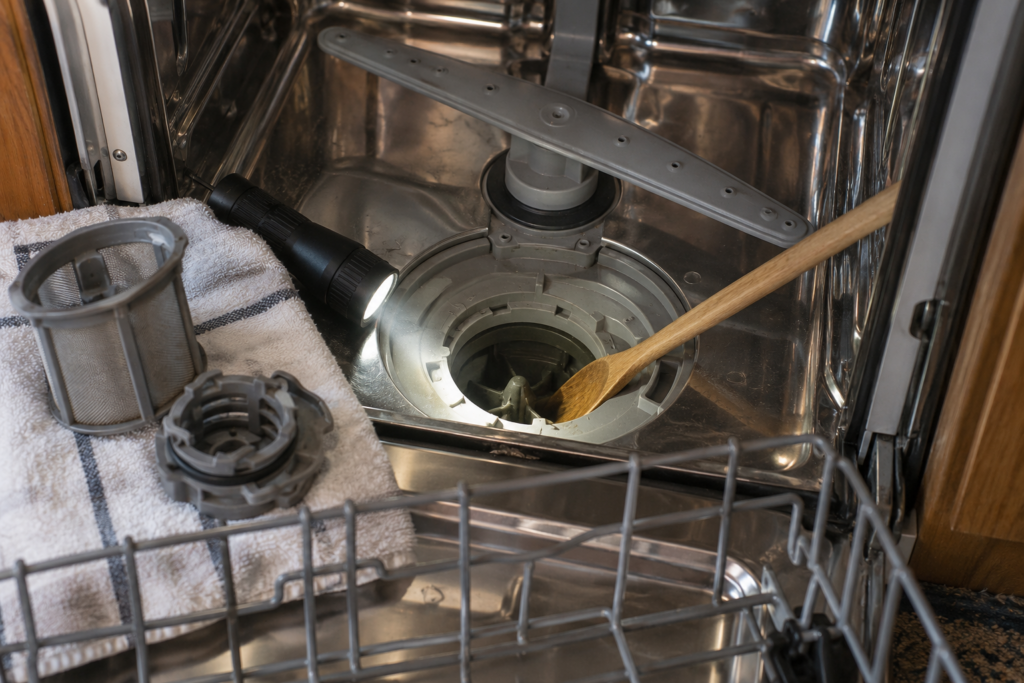
- Look and turn the impeller gently. With the filters out and the power off, a flashlight shows broken glass or a pit, and a wooden spoon handle should turn the impeller freely.
- Run a hot empty cycle with a degreaser. The code page suggests a dishwasher-safe degreaser or white vinegar to dissolve grease through the system.
Listen as well as look. A smooth hum is normal. A surging, pulsating or screeching pump is telling you about bearings or windings, and that is the point to stop and book a technician rather than keep running cycles.
Why Should You Stop Using the Machine While the Code Shows?
Because a struggling pump can finish itself off. The F78 page warns that a pump running under excessive load can overheat and burn out, and that continuing to use the dishwasher risks permanent motor damage and a much more expensive repair. For F51 the page says plainly that the machine cannot wash without the pump, so running cycles only wastes water and energy.
The same rule keeps a cheap repair cheap. A dishwasher that was cleaned and left alone after the first F78 usually needs a cleaning job. One that was run for another week on a strained pump can arrive at the technician with a ruined motor.
When the Pump Decision Tips Toward Replacing the Machine
Almost never because of the pump alone. The decision tips when the pump is one of several problems or when the machine has already been through repairs. Look for these signs together, not one at a time, and ask the technician to say which of them applies to your machine in the written estimate.
- Several systems failing. A pump, a heater and a board problem in the same year is a pattern, not bad luck.
- Rust in the tub. Structural damage cannot be repaired, whatever the pump does.
- The same code after a repair. A pump replaced once that fails again points at the wiring or the board.
- A machine well beyond its expected life. Age moves the line, and the larger the estimate against the price of a new Miele, the harder the question gets.
A circulation pump repair typically starts from $250 for F51 on this site, with the final price confirmed after diagnosis and a written estimate before work begins. For the cost picture across all dishwasher codes, read Miele dishwasher repair cost by fault code, and for the broader replacement decision see Miele dishwasher repair or replace. If water is standing in the tub instead, the problem is drainage and not the pump; start with the guide to a Miele dishwasher not draining. Our dishwasher repair service covers every code here; schedule a visit or contact us with the code and the model number.