 Daniel Mitchell
Key Takeaways
- Our guides give a Miele washer a 20-year design target, tested to the equivalent of 20 years of use; treat it as a ceiling, not a guarantee.
- Limescale on the heater, mould on the door seal and residue in the drain are the three slow problems that cut that life short.
- Wiping the seal, leaving the door ajar, a monthly hot wash and filter clean, and descaling every three to six months prevent most of them.
- Rust marks on laundry and spider arm corrosion are end-of-life signals; so are three technician visits in a year.
- Under 12 years old a reasonable repair is usually worth doing; at 15 years or more with a major failure, replacing is likelier.
The Bottom Line
A Miele washer is built to last about 20 years if the seal stays dry, the drain stays clear and limescale is kept off the heater. Watch for rust marks and a run of repairs, which say more about its remaining life than its age does.
Most people ask how long a Miele washer will last when they are deciding whether to repair one or buy another, and the honest answer has two halves. One half is the design target, which is long. The other half is how the machine is treated, which decides whether it gets there. This guide sets out what our own guides say about the lifespan of a Miele washing machine, the habits that protect it and the signs that it is near the end. Habits are what an owner controls, so they come first in the table below.
| Habit | How often | What it protects |
|---|---|---|
| Wipe the door seal dry | After the last wash of the day | Door seal from mould |
| Leave the door slightly open | Between washes | Drum from trapped humidity |
| Run a hot maintenance wash | Monthly | Drain system from detergent residue |
| Clean the detergent drawer and its recess | Monthly | Dispenser from residue and mould |
| Clean the drain filter | Monthly | Drain pump from a blockage |
| Descale | Every 3 to 6 months | Heating element from limescale |
| Inspect the inlet hose | Every 6 months | Floor from a burst hose |
| Check level and drain hose loop | Once a year | Drum and bearings from vibration |
How Long Do Miele Washing Machines Last?
About 20 years is the design target, and our guides give it two ways. The maintenance schedule says Miele washers are engineered for a 20-year lifespan, but that the figure assumes regular maintenance. The guide on whether a Miele washer is worth repairing says they are tested to 20 years of use, which is why it treats a 12-year-old machine as middle-aged, not elderly. Miele's own published testing describes about 10,000 operating hours, which it equates to roughly 20 years of household use; it is a design target and a test result, not a warranty.
Treat 20 years as a ceiling you can reach, not a guarantee. A machine that runs daily reaches its tested hours sooner than one that does a few loads a week, and hard water, neglected seals and a drain that is never cleaned all take years off the total. The sections below cover what you can influence.
What Shortens the Life of a Miele Washer?
Three slow problems, all of them avoidable. The maintenance schedule names them directly: limescale builds up on the heating element, mould colonizes the door seal, and detergent residue clogs the drain system. All three lead to repairs that are entirely preventable.
- Limescale. In hard water it coats the heating element and cuts efficiency. Descaling every three to six months is the answer.
- Mould on the seal. A closed door traps humidity in the drum, which is ideal for mould and mildew. Wiping the seal and leaving the door ajar stops it.
- Residue in the drain. Detergent and lint collect in the filter and pump. A monthly filter clean prevents a blocked drain.
- Running on worn parts. Our loud-noise guide warns that running a washer on worn bearings damages the drum and the seal behind it, so a grinding noise should be dealt with early.
The Monthly Routine in Detail
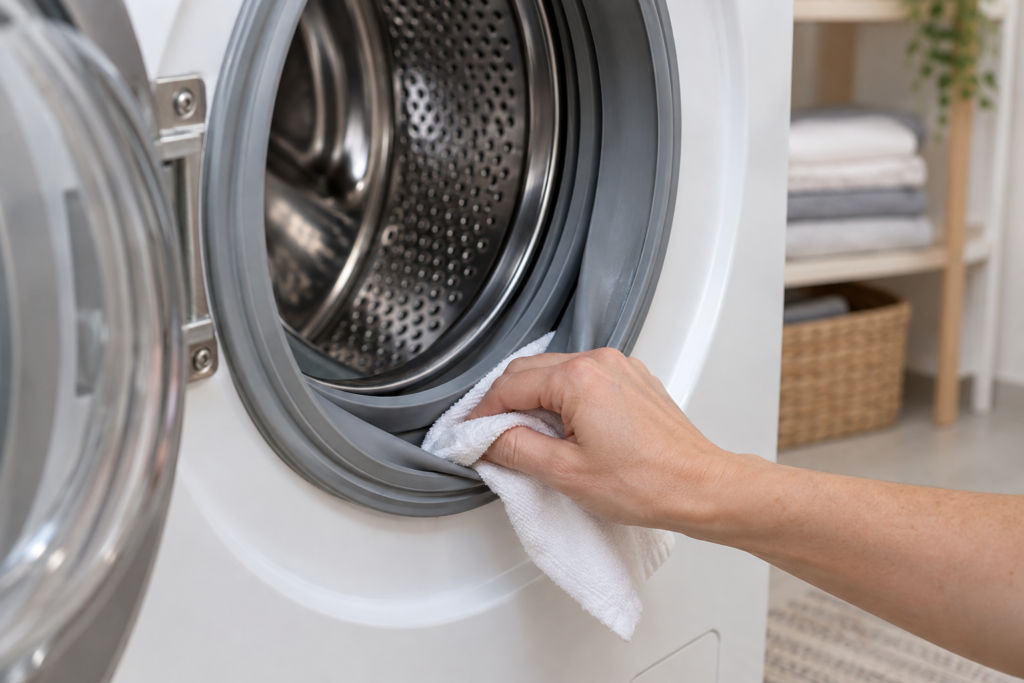
The routine is short, and most of it takes minutes. Pull back the folds of the rubber door gasket after your last wash and wipe out trapped water, lint and debris with a dry cloth; our schedule credits that single habit with preventing most door-seal mould problems.
- Hot maintenance wash. Run an empty cycle on the cotton program at 60°C (140°F) or 90°C (194°F), with a washing machine cleaner or citric acid in the drum, to dissolve residue and flush the drain.
- Detergent drawer. Remove it completely, rinse it under warm water, scrub buildup with an old toothbrush and clean the recess it sits in, where residue and mould hide out of sight.
- Drain filter. Open the service flap at the bottom front, put a shallow tray underneath and unscrew the filter slowly to let trapped water out. Remove lint, coins and debris.
- Inlet hose. Every six months, check the hose at the rear for cracks, bulging or discoloration. If it is more than ten years old, replace it proactively, since rubber degrades even without visible wear.
- Level and drain loop. Once a year, check the feet with a level on top of the machine and confirm the drain hose is secured with its loop at least 60 cm (about 2 feet) above the floor, which prevents siphoning.
What Are the Signs a Miele Washer Is Near the End?
Corrosion on the drum assembly and a record of repeated repairs matter more than the date on the rating plate. Our worth-repairing guide says spider arm corrosion and rust marks on laundry are the end-of-life signals, not age. Our repair-or-replace guide gives the strongest signal of all: three or more technician visits in the past year means the machine is in systemic decline and individual repairs will keep coming.
- Rust marks on laundry or spider arm corrosion. The signal that the drum assembly itself is wearing out.
- A rough, grinding drum. Worn bearings; bearing replacement is the tipping-point repair on an older machine.
- Parts on back-order with no date. Miele keeps parts available for roughly 15 years after a model is discontinued, and past that window controls and motors get hard to find.
- A string of small repairs. Three visits in a year is a pattern, not bad luck.
Is It Worth Repairing an Older Miele Washer?
Usually, yes, up to a point: the guides say repair if the machine is under 12 years old and the cost is reasonable, and replace if it is 15 years or more with a major component failure. In between, weigh the quote against half the price of a comparable new machine. A diagnostic visit from $89 tells you what you are actually dealing with before you decide, and the final price is confirmed after diagnosis, with a written estimate before work begins.
The decision tables are in the washing machine repair vs replace guide and the guide on whether a Miele washing machine is worth repairing. Typical repair prices are in the washing machine repair costs guide.
A Simple Plan for the Years Ahead
Older machines also use more water and energy than current models, which our repair-or-replace guide counts as a reason to lean toward replacing only when a major repair is quoted, not as a reason to scrap a washer that works. Keep a short log of every repair with its date and cost, because the log is what makes the three-visits-in-a-year rule easy to apply and gives a technician the history of the machine. A washer that has had one well-chosen repair and regular care is a better bet than one with an unknown past.
Put the monthly tasks on a calendar and pair the six-monthly ones with something you already remember, such as the clocks changing. Our full routine is in the washing machine maintenance schedule, and if a flood is your main worry, read about washing machine flooding prevention. Our preventive maintenance service covers the checks you would rather not do yourself; schedule a visit or contact us if the washer is making a new noise or showing a code.