 Daniel Mitchell
Key Takeaways
- Spots on glasses, damp dishes and a refill light that stays on are the everyday signs of a dispenser problem; F52 is the machine noticing it.
- Fill the reservoir to the MAX line only; overfilling causes foam and residue that can block the dispenser.
- Wipe the opening, swab the nozzle and test the lid by hand about once a month.
- F52 does not affect washing or sanitizing, so the machine is safe to use while you check the dispenser.
- The final price is confirmed after on-site diagnosis, with a written estimate before any work begins.
The Bottom Line
Five minutes of dispenser upkeep a month keeps a Miele dishwasher spot-free and keeps F52 away. Refill to MAX, wipe and swab the opening, test the lid, and book a visit only if the code returns.
The rinse aid dispenser is the quietest part of a Miele dishwasher and the one whose failure shows up on the glassware first. Spots on glasses, dishes that are still wet after drying and a refill light that stays on are the everyday signs, and F52 is what the machine shows when it notices the dispenser has not released rinse aid when it should. Meaning and repair of the code are on the Miele dishwasher F52 page; this guide is about the upkeep that stops you reaching that point.
| Task | What it prevents | How often |
|---|---|---|
| Refill to the MAX line | An empty reservoir, the simplest cause of F52 | When the refill light comes on |
| Wipe the opening and lid | Dried residue blocking the dispenser | About once a month |
| Swab the nozzle area | A clogged dispenser nozzle | When glasses start spotting |
| Open and close the lid by hand | A sticking hinge or latch | Every few months |
| Check the dosage setting | Too little rinse aid reaching the final rinse | After any change of product |
What Does Miele Rinse Aid Dispenser Care Involve?
Miele rinse aid dispenser care takes about five minutes and uses nothing but a cloth, a cotton swab and the rinse aid itself. It has three parts: keep the reservoir filled to the correct level, keep the opening clean so it can release, and make sure the dosage is set so that enough rinse aid is delivered. None of it needs a panel off, and this site's F52 page says the owner checks need no disassembly at all.
A refill light that stays on right after you have topped up is worth noticing. The code page lists it as a symptom: the indicator remains active even when the reservoir is full, which suggests the machine is not registering the product being used or the dispenser is not working as expected. Treat that, together with water spots, as the early version of F52.
The reason it matters is that rinse aid does a job nothing else in the cycle does. The code page explains that without it water does not sheet off the dishes properly, which is why glasses come out marked and why dishes stay damp after the drying phase.
How Do You Refill It Without Causing Problems?
Fill the compartment to the MAX line with Miele rinse aid or a compatible product, and stop there. The compartment is usually next to the detergent dispenser. The page warns that overfilling causes excessive foam and residue, which is the opposite of the clear rinse you are after and can leave residue that clogs the very opening you are trying to keep open.
- Wipe up any spill on the rim before closing the lid; dried rinse aid is what blocks the dispenser.
- Refill when the light says so, not when the glasses start spotting; the light is your early warning.
- Use a product made for dishwashers, and do not mix products in one reservoir.
- Do not top up above MAX on the theory that more rinse aid means shinier glasses.
How Do You Clean and Check the Dispenser?
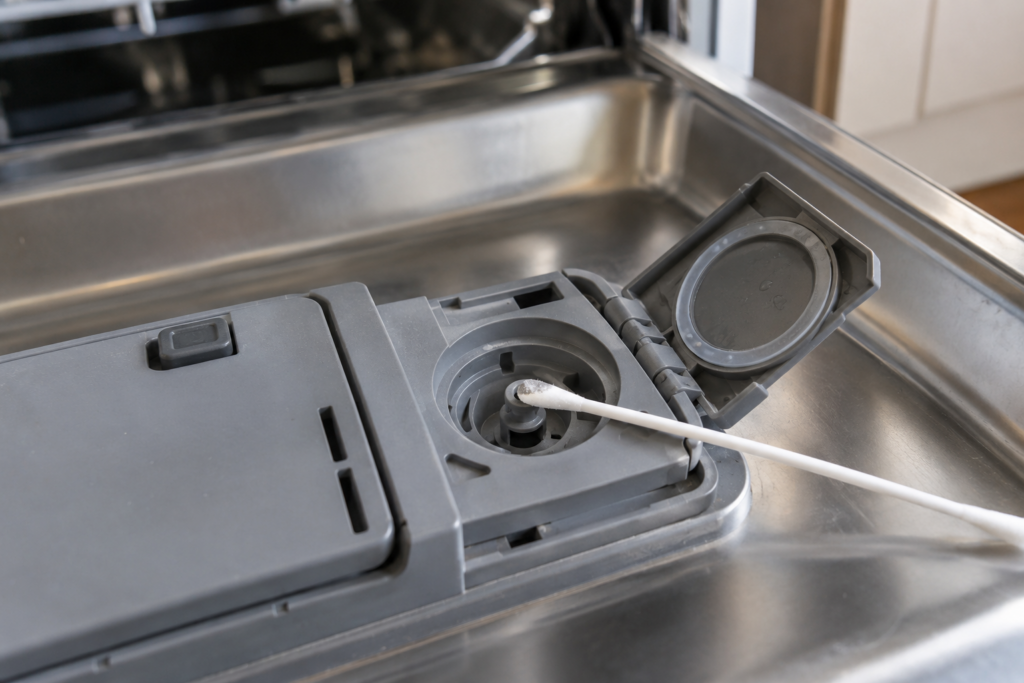
Wipe the opening and the lid with a damp cloth, then use a cotton swab inside the nozzle area for anything dried on. The code page notes that a cotton swab works well there, and that running warm water through the opening clears a blockage. Then work the lid by hand: it should click shut firmly and spring open freely, and the hinge and latch should be free of cracks and debris.
- Wipe the opening and lid with a damp cloth, looking for dried rinse aid.
- Clear the nozzle with a cotton swab and a little warm water.
- Open and close the lid and check the hinge and latch for cracks or grit.
- Look at the dosage setting: Miele dishwashers have an adjustable rinse aid dosage, usually 1 to 6, and the page suggests trying 3 or 4 if yours is set to 1.
The user manual for your model shows how to change the dosage. Keep the change small and run a full cycle afterward before judging it.
Is It Safe to Keep Running the Dishwasher With F52?
Yes. The code page says F52 does not affect washing or sanitizing, so the dishes are still cleaned, and the cost of carrying on is water spots and slower drying. It also says a power reset can clear it: refill the rinse aid and switch the machine off at the mains for five minutes, and if the dispenser mechanism is working the code will clear.
Stop and call if the dispenser leaks rinse aid into the tub before the final rinse, or if you hear it click and then fail to open. Those point at the solenoid or the lid rather than at the upkeep. The page puts a typical professional repair from $80, and the final price is confirmed after on-site diagnosis, with a written estimate before any work begins.
What Fails When Upkeep Is Not Enough
If the reservoir is full, the opening is clean and the lid moves freely, and F52 still appears, the fault has moved inside the machine. The code page lists three causes that need a technician, and knowing them helps you describe the problem accurately.
- A faulty dispenser solenoid: the electromagnetic valve that opens the dispenser does not receive or answer the signal, so you hear no click during the rinse phase.
- A damaged lid or seal: the lid does not open properly during the cycle, or the seal has deteriorated and rinse aid leaks out early.
- Wiring to the dispenser: a loose connector or damaged wire between the control board and the dispenser interrupts the activation signal.
When you call, mention whether F52 appears on every cycle or only on some. The page notes it can show intermittently, depending on whether the dispenser manages to release partially, and that detail helps a technician judge between a marginal solenoid and a wiring fault.
Habits That Keep the Whole Dishwasher Healthy
Keeping a short written note next to the machine helps more than it sounds: the date of the last refill, the dosage setting and any day F52 appeared. After a few weeks the note tells you whether the dispenser is slowly losing ground or whether one odd cycle was a fluke, and it is exactly what a technician asks for first. The dispenser is one of several small parts that fail from neglect instead of wear, and the same few minutes of attention protect the others. Our dishwasher maintenance guide covers the filters and spray arms, and keeping the flow meter healthy is the companion for the water side.
- Refill before the light has been on for a week, so the dispenser never runs dry mid-cycle.
- Keep the rim dry and clean so residue cannot build up around the lid.
- Write down the dosage setting you settled on after changing it.
- Treat a returning F52 as a parts question and not a cleaning one.
If the dispenser has been cleaned, refilled and reset and F52 still returns, the Miele dishwasher repair service covers the solenoid, lid and wiring, and preventive maintenance is the route if you would rather have the small parts checked on a schedule. When you are ready, schedule a visit.