 Daniel Mitchell
Key Takeaways
- F87 is logged as the turbidity (water clarity) sensor not functioning correctly — a sensor most owners never think about.
- The sensor reads optically and sits near the filter assembly, so residue from an under-cleaned filter can cloud its reading over time.
- Weekly filter rinsing and a monthly deeper clean are the routine that prevents most F87 cases.
- If a thorough filter clean does not resolve F87 within a cycle or two, the sensor itself has likely failed and needs replacement.
- A confirmed sensor replacement starts from $130 and a diagnostic to confirm the cause starts from $89.
The Bottom Line
F87 is usually preventable with the same filter cleaning routine that keeps a dishwasher running well overall. Try a thorough clean first; if the code persists, the sensor itself needs a diagnostic, not more cleaning.
A Miele dishwasher F87 error points at a sensor most owners have never heard of, and the routine care that prevents it is the same filter cleaning many households already skip. Once you know what the turbidity sensor actually does, the maintenance connection is straightforward.
| Filter cleaning habit | Effect on the turbidity sensor | Recommended interval |
|---|---|---|
| Filter cleaned weekly | Sensor lens stays clear, readings stay accurate | Weekly rinse, deeper clean monthly |
| Filter cleaned occasionally | Gradual film buildup can affect sensor accuracy over time | At minimum, monthly |
| Filter rarely or never cleaned | Food residue and film reach the sensor lens directly | Overdue — clean immediately |
What Does F87 Mean on a Miele Dishwasher?
F87 means the turbidity sensor — the water clarity sensor that measures how soiled the wash water is during a cycle — is not sending a reliable reading. This site logs F87 as the turbidity sensor not functioning correctly. That sensor is what lets Miele's automatic and sensor-based programs decide whether the water needs another rinse or is clean enough to move to the next stage, so a sensor sending an unreliable signal affects how well the whole cycle adapts, not just one component.
Why Filter Cleaning Prevents This Fault
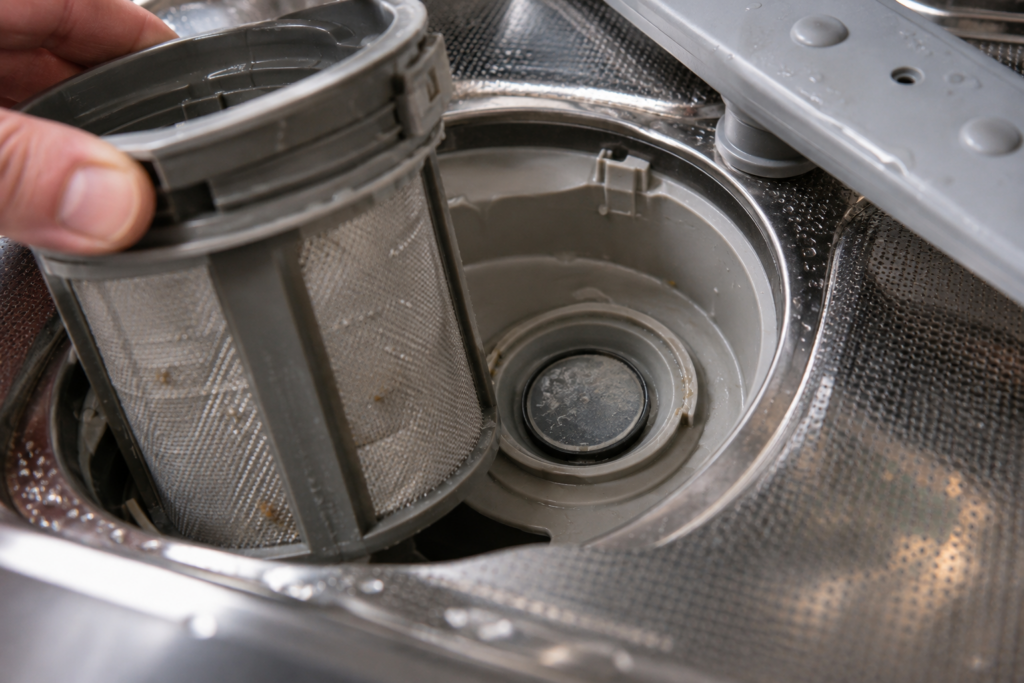
Because the turbidity sensor works optically, reading how much light passes through the wash water, and it sits close to the same filter assembly that catches food debris during every cycle. A filter that is rarely cleaned lets more residue circulate through the wash water and settle near the sensor's lens, gradually clouding the reading it can take even when the water itself would otherwise register as clean. Over time that film can be enough for the sensor to report values the control board no longer trusts.
- Rinse the filter assembly weekly under running water to clear loose debris before it accumulates.
- Do a deeper filter clean monthly, removing and washing all filter components rather than just rinsing in place.
- Wipe the area around the sensor lens during the deeper clean if your model allows visual access to it.
- Avoid pre-rinsing dishes so thoroughly that you assume the filter needs no attention — some food residue reaches the filter regardless.
Is F87 Always a Cleaning Problem, or Can the Sensor Just Fail?
Not always — a turbidity sensor can fail on its own from age or a wiring fault, independent of how well the filter has been maintained. The distinction worth checking before assuming a cleaning fix will work: if a thorough filter clean does not resolve F87 within one or two cycles, the sensor itself, or its wiring connection, has likely failed and needs replacement rather than more cleaning. A confirmed sensor replacement starts from $130, and a diagnostic that distinguishes a dirty sensor from a failed one starts from $89.
Does F87 Affect How Clean the Dishes Come Out?
It can, indirectly, because sensor-based programs rely on an accurate turbidity reading to decide how much rinsing a load actually needs. A sensor reporting inaccurate values can cause a program to under-rinse a heavily soiled load or over-run a lightly soiled one, neither of which is dangerous but both of which are wasteful — either dishes that need a second wash or a longer cycle than necessary using more water and energy than the load required.
Our guide to dishwasher maintenance guide sets the filter-cleaning interval in the context of the machine's full maintenance schedule, alongside the descaling habits that prevent F14 and the flow-related checks behind F67, which our F67 flow meter prevention guide covers separately.
Building This Into a Routine You Will Actually Keep
The households that avoid F87 entirely are rarely the ones with a stricter cleaning schedule on paper — they are the ones who pair the filter clean with something they already do weekly, so it never becomes a separate task to remember.
- Pair the filter rinse with a task you already do weekly, like taking out the trash or a weekend kitchen deep-clean.
- Keep a small brush near the dishwasher specifically for the filter, so cleaning it takes under a minute.
- Note the date of your last deeper clean somewhere visible, since it is easy to lose track of a monthly task.
- Book a diagnostic promptly if F87 persists after a genuine cleaning attempt, rather than repeating the clean hoping for a different result.
Dishwasher service is covered under Miele dishwasher repair. When you are ready, schedule a visit and mention whether you have already tried a thorough filter clean.
Detergent Type Plays a Small Supporting Role
Somewhat. Detergents that leave more residue behind, or gel-style products that do not rinse as cleanly as powder or tablet formulations on some cycles, can contribute slightly more film buildup near the filter and sensor area over time. This is a minor factor compared to filter cleaning frequency, but households already on the edge of the recommended cleaning interval may find that switching detergent types, or simply cleaning slightly more often, closes the gap without much additional effort.
Rinse aid plays a supporting role here too — a dishwasher run consistently low on rinse aid tends to leave more spotting and residue throughout the tub, which is one more small contributor to the film that eventually affects sensor readings if filter maintenance is already borderline.
- Keep the rinse aid reservoir filled as part of the same routine as filter checks.
- Consider your detergent type if you are already at the edge of the recommended filter-cleaning interval.
- Do not treat detergent choice as a substitute for actual filter cleaning — it is a minor factor, not a fix on its own.
- Switch detergent types gradually if you suspect residue buildup, so you can judge whether it actually made a difference.
Poor Filter Maintenance Can Cause Other Codes Too
Yes — a neglected filter is one of the more common upstream causes behind several different dishwasher faults on this site, not just F87. Reduced water flow from a clogged filter can contribute to drain-related codes, and residue reaching other sensors in the tub can affect readings beyond turbidity alone. Treating filter care as foundational maintenance, rather than something to address only after a specific code appears, tends to prevent more than one fault at once. It is a small habit with an outsized payoff, given how many separate codes trace back to the same neglected part of the machine.
Our guide to Miele dishwasher F24 drain fault covers one of the codes that a neglected filter can eventually contribute to, and it is worth reading if you are seeing sluggish drainage alongside F87 rather than F87 alone. The two faults share a common root cause often enough that fixing one without checking the other leaves the door open for a second service call within a few months.