 Daniel Mitchell
Key Takeaways
- F12 is a water intake problem: the tub did not reach its level in the time the program allows.
- A partly closed supply tap is the single most common cause, ahead of any failed part.
- The inlet mesh screen collects scale and grit for years, so the fill rate drops gradually and the code seems to arrive out of nowhere.
- A buzzing inlet valve with a confirmed good supply means the solenoid has failed and needs replacing.
- Running cycles with F12 active risks the wash pump, which relies on the water it moves for cooling.
The Bottom Line
Start at the shut-off valve, then the hose, then the inlet screen — that sequence resolves most F12 cases without a service call. A valve that buzzes with the supply confirmed strong is the point where the job moves inside the machine.
A Miele dishwasher F12 error is the machine telling you it never got the water it asked for. The program begins, the inlet valve is commanded open, and the control board watches for the tub to reach its level. When that does not happen within the allowed window, the cycle stops and F12 appears. Unlike a heating or drainage fault, this one is very often solved without a service call — but only if you check things in the right order.
| Symptom | Most likely cause | Who fixes it |
|---|---|---|
| Tub is nearly empty, no water sound at all | Supply tap closed or part-way closed | Homeowner |
| Faint flow, then the cycle stops | Kinked or scaled inlet hose | Homeowner |
| Fill is weak in every program | Clogged inlet filter screen | Homeowner |
| Valve buzzes, nothing enters the tub | Failed inlet solenoid valve | Technician |
| Code only when other fixtures run | Low household water pressure | Homeowner |
What the Code Reports
This site's F12 reference defines the code as a water intake problem: the tub did not fill to the required level within the allowed time, or the flow rate stayed below the expected threshold. In practice that means the board never saw the water it was waiting for.
The single most common cause is not a part at all. On these machines the supply tap accounts for roughly four cases in ten. It gets closed for a plumbing repair, for a vacation, or when the machine is pulled out for a kitchen job, and it gets turned back most of the way rather than all of the way. A dishwasher needs a fill rate, not just a trickle, and a valve that is three-quarters open will not deliver it.
Check It in This Order
Working outward from the machine toward the plumbing is the fastest route, because each step also tells you something about the next one.
- Open the shut-off valve fully. It is normally under the kitchen sink. Turn it counterclockwise until it stops.
- Look at the hose. Ease the machine forward and follow the supply hose end to end. It should curve gently, with no sharp bend within a hand's width of either connection.
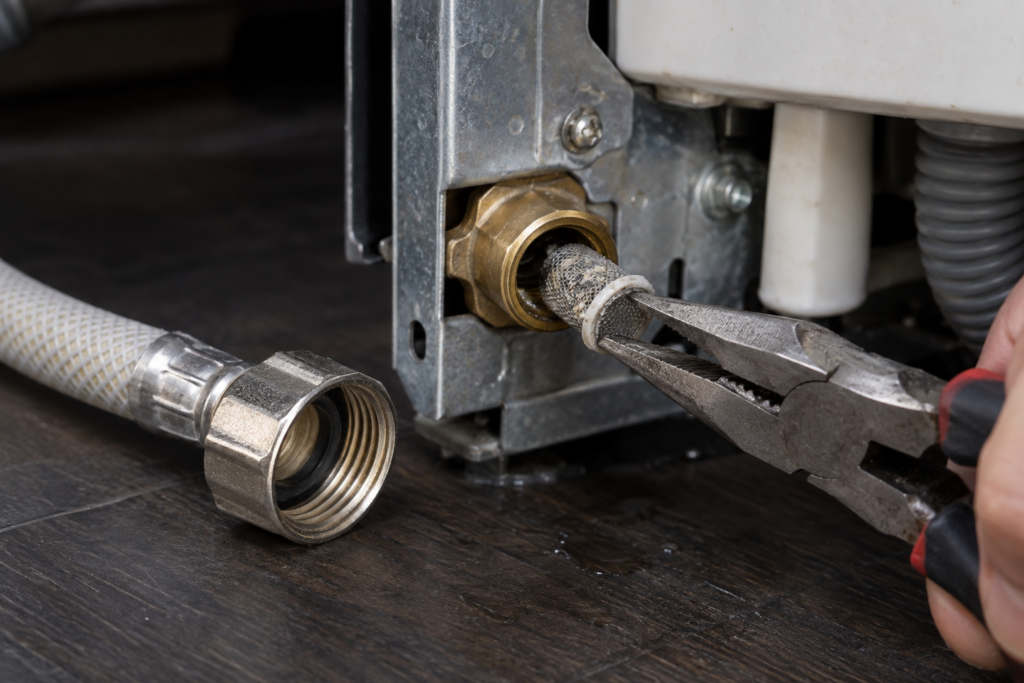
- Pull and rinse the inlet screen. Shut the water off, unscrew the hose at the machine, and lift out the small mesh filter with pliers. Rinse it; in hard water, soak it in white vinegar for fifteen minutes.
- Test the household pressure. Run the kitchen tap on its own with nothing else drawing water. A weak stream means the problem is upstream of the dishwasher entirely.
- Reset and watch. Cut power at the mains for five minutes, restart, and watch whether the tub fills normally.
The reset is last for a reason. It clears the display, not the cause. If the supply is still restricted, the code comes straight back, and all a premature reset does is cost you another wasted cycle.
Why Hard Water Produces This Code
The mesh screen at the machine's inlet is the last defense between your plumbing and the fill system, and it collects everything your pipes shed: grit stirred up by street work, flakes of old galvanized pipe, and mineral scale. None of that is dramatic on its own. It accumulates as a thin mat across the mesh, and the fill rate falls a little each year until one day it falls below what the program tolerates.
That gradual pattern is why F12 so often arrives without warning in a machine that has run perfectly for years. It also explains why a single cleaning of the screen can restore normal behavior completely. If your home is on hard water, treat this as annual maintenance rather than a repair — the same logic that puts the filters and spray arms on a schedule.
When It Really Is the Valve
A failed inlet valve gives itself away. You will hear a buzz or hum from the back of the machine as the solenoid is energized, and no water will follow. Confirm the tap is open and the screen is clean first — a valve straining against a starved supply sounds much the same — but a buzz with a confirmed strong supply means the valve is the part to replace.
Two more signs move the job to a technician. The first is an AquaStop supply hose showing its red indicator, which means the safety hose has triggered and must be replaced rather than reset. The second is F12 appearing alongside F13, the fill timeout code. Seeing both is not a coincidence; it is an intake system degrading, and the machine is telling you so in two different ways.
Should You Keep Running It?
No, and the reason is mechanical rather than cautious. The wash pump is cooled and lubricated by the water it moves. A pump running in a tub that is nearly empty runs dry, heats up, and can fail — turning an afternoon with a pair of pliers into a real repair. Poor wash results and detergent residue on the dishes are the mild version of the same problem.
- Stop starting new programs until water is confirmed to be entering normally.
- Do not force a cycle in the hope that the machine will work through it.
- Note what you hear. Silence, a click, and a sustained buzz are three different diagnoses.
- Check the drain side too if water sits in the tub between cycles — our guide to a Miele dishwasher that will not drain covers that half of the system.
Getting It Looked At
If the tap is fully open, the hose is straight, the screen is clean and the pressure at the tap is strong, the remaining work is inside the cabinet and belongs to a technician. Our Miele dishwasher repair service covers the inlet valve, the intake wiring and the control side of the fill system. The site's own figure for this repair starts from $100, with the final price confirmed after the on-site diagnosis and a written estimate before any work begins.
Come to the appointment with the details: which checks you ran, what changed, and what the machine sounds like when it tries to fill. You can book a visit in a couple of minutes, and that short list of observations reliably takes time off the diagnosis.